Grammar, A Cautionary Tale

I was born into a family of wordsmiths and storytellers, people who loved the English language and all of its rules. They’d been taught in the 1950s when verbs and adverbs, nouns both common and descriptive, felt better in a perfectly diagrammed sentence.
My mother, aunt and grandmother were all there to correct your grammar—regardless of context—-in unapologetic Bronx accents.
Only one in every few sentences passed their exacting exam.
“Examination,” they would correct.
While I was trying to figure out life, they were shaping my expression of all of it, my feelings, my words...
“I can’t stop crying,” I told my mother.
“Try harder.”
“I don’t think it works that way. I been sad for a long time,” I admitted.
“You have been sad,” she corrected.
“I have been sad.”
“A long time? Are you sure? You haven’t been alive that long.”
“Sure? I ain’t sure about nothin,” I’d tell her out of spite. And this was true. Their exacting critique was difficult to navigate through and filled me with a declarative certainty that I couldn’t do anything right.
“Appearances mean something. If the grammar is correct, everyone will assume you’re smart,” she told me.
“And if it ain’t?” I joked.
“Dumb as a box of rocks.”
“As dumb…” I corrected. It didn’t happen very often, but I was thrilled when it did.
While I was a talker, my sister was a study in solitude. No wonder she preferred reading. There was no one behind her looking for typos.
Beyond crossword puzzles and faking intellect, I wasn’t sure that perfect English was necessary. Some mistakes do not need to be corrected. Faulty grammar can stay faulty grammar and no one will be hurt, an utterly victimless crime. I’m surprised that I was well into my twenties before I had that realization.
Still, the judges in my family were far less forgiving. When I took on a Puerto Rican accent in third grade so I could crush on Miguel from Menudo with my friends, I thought my mother might lose her mind.
“Get a grip and speak the King’s English.”
“What does the king have to do with it?”
“Kate, it’s ridiculous—borderline offensive.”
I stopped, because the last thing I wanted to be was offensive. I do wonder what became of Miguel. He was my favorite of the five prepubescent boys in the band. Most of my friends liked Ricky Martin, but I never wanted to be like everyone else.
My family’s exacting wasn’t aimed solely at proper sentence structure. It applied to everything in my life. No mistake went unmentioned. It was their job to show me the “right” way to speak, to love, to act and to care for my family. They practiced little of it themselves, but they made great sport of pointing it out. Apparently I was rarely right about anything on the first try. At least, that I can remember.
The chorus of them chased me, pointing at all my fuck ups. When I cleared the table, I’d forgotten some scrap of napkin somewhere. When I swept, there was always a corner I’d left out. My clothes didn’t match. I ate too much. The dishwasher was not loaded the proper way.
“Don’t be lazy,” my mother would say regarding my improper loading of the dishwasher, often with the unspoken implication, like your father who ruins everything. “They’ll never get clean unless you wash them first.”
I wanted to take what she said on face value, but a lot of it was beyond my intuitive sense. I made her convince me every time, shoving every plate into the rack resplendent with caked on pasta sauce.
My father, the writer, didn’t bother to bother himself at all with verb agreement or anyone else’s. He made pronouncements and reveled in the fallout.
“He is a playwright,” my mother corrected me. “People don’t use the proper punctuation while speaking.”
“Besides you?”
“And you, Katchkula,” she smiled. “You’re welcome.”
I assumed everyone’s family was busy teaching their kids perfect English. My friends were first generation, or non native speakers. Their grammar often came from what they heard in the streets or on television. Like in my family, I assumed they’d want to know. No one was more surprised than me that wasn’t the case. They went beyond language to prove their worth.
In a courtyard, behind the high school, a place we all knew to be the smoking section—teachers and students alike—I continued my English lessons.
“Ain’t isn’t a word,” I told them.
Instead of thanks, I got a scrunch of the eyebrows and a sad shake of the head.
“Fuckin’ A it is. What kind of bullshit is that?” Then someone would raise the volume on the boombox or the kids across the courtyard would call out that they were going for pizza and we’d follow.
Sadly, I pursed my lips. Mom was right. Just like a box of rocks.
By the time I was a teenager with adult friends, I’d figured out that perfect grammar wasn’t necessarily a goal for everyone. Though it was a struggle, I kept my corrections to myself.
My husband only learned to speak English when he came to this country at eleven, and while his grammar is nearly perfect, it is only nearly. Do I tell him? Does he want to know? Is it rude to correct people when no one is asking? Damn right it is. Grammar and otherwise.
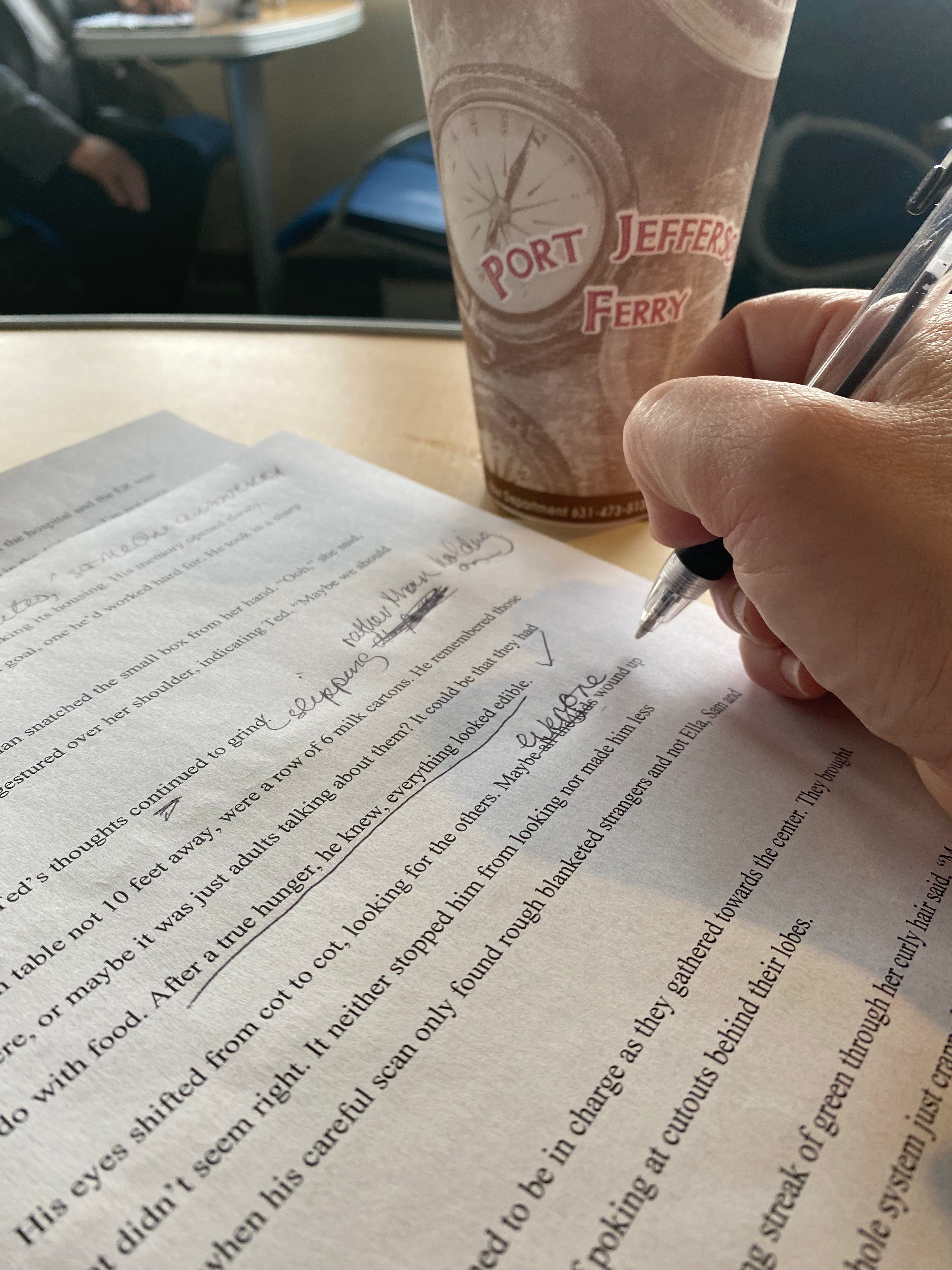
Then, miraculously, someone offered to pay me for it. Editing called to me in a way few things did. They wanted me to correct them. In fact, there were people who’d pay me for it. With my actual red pencil, I moved words around on a page, crossing out here, asking for more information there. I couldn’t remember what the words and clauses were called or the technical names of the rules, but like a musician who doesn’t exactly read notes, I still played by ear.
Retraining my laser focus on hearing only my mistakes has been a challenge—both grammatically and personally. I am often searching for a way to correct something. This is good, but wouldn’t this be better?
Wherever I looked, there was a right answer that was waiting for me just around the bend. One more tweak, one more zhuzh to make it pop. But what if just right, is a matter of opinion? Changeable and in the moment? Could I stop myself from negating every success or pride filled good feeling I’d ever had? Instead of coming to a finite conclusion, could I fudge the edges and push through?
I joined a writing critique group whose formula includes reading your work aloud. The group can only tell you what they like. There was no advice about fleshing out characters or shifting perspectives. No one minded if your tenses proved a bit too tense. It took some time to settle my mind.
I knew that I could make it better with my thoughtful insight, but that wasn’t the point, and it moved things around in my brain just a bit. It was like finding that puzzle piece that unlocks the rest of the pattern.
Because while I was looking for the flaws in everything, I missed the sunrise more often than not. While I was searching for the one dead tree in the forest, I missed the smell of mossy lushness in the undergrowth, the sound of chittering birds flying through the trees, and the dappling of sunlight through velvet green leaves. All things I thoroughly enjoy now.
It was sadly true of who I was as a mother, a wife, a friend and a human. And now that I know, I can’t help but be sad for all those versions of me, that girl and then woman, who spent years achieving her dreams but thinking only about the ways she was doing it wrong.
Of course I brow beat my kids in English. I understood my assignment. It came with the job title, correcting them every chance I could, because while I have never needed to place a napkin properly inside a ring, and dishes do do themselves nowadays, I have carried my English as a secret weapon. It’s one I brandish proudly.
I have stopped listening for their flaws now. They’re in their early twenties, it’s their problem. My lips are shut tight. Mostly.
But you bet I take great pleasure in anytime someone says to them, “Great point. I hadn’t thought of it that way.”
And I know that my boys, fueled by the exacting grammar of their ancestors, at least sound smarter than a box of rocks. Somehow, that makes it all worth it.
Wonderful piece! My mother was an English corrector too, long before she became an English teacher. I am too, even though no one ever paid me for it. Just ask my husband.